
When Should You Use PEMF Therapy? (Daily Use Guide for Best Results)
When Should You Use PEMF Therapy? (Daily Use Guide for Best Results)
How Often to Use PEMF for Real-Life Results
If you’re new to PEMF, the big question is usually: how often to use PEMF so it actually works, without turning it into a part-time job. The good news? You don’t need long, complicated protocols. For most people, a simple PEMF therapy daily routine of short, consistent sessions works best. Think of PEMF like brushing your teeth or taking a daily walk. A little bit, done regularly, will usually beat a huge, intense session once in a while. Most users start with one or two short sessions a day, then adjust based on energy, pain levels, sleep, and recovery. The key isn’t perfection. It’s building a rhythm your body can rely on. At Get Pulsed, clients often see better results when PEMF is treated as a passive health habit—something you can do while reading, watching TV, scrolling your phone, or even resting with your eyes closed. That “low-friction” approach makes it much easier to stay consistent over weeks and months.
PEMF Therapy Daily Routine: Make it a Passive Habit
To design a PEMF therapy daily routine you’ll actually follow, anchor it to things you already do every day. Instead of asking, “When should I use PEMF?” ask, “What am I already doing where I could just lie on a mat or sit in a chair for 10–20 minutes?”
Some easy ideas:
- While drinking your morning coffee or tea
- During your lunch break
- While watching TV in the evening
- While reading or scrolling in bed before sleep
The goal is to remove the “setup stress.” If your session feels like a big task, you’ll skip it. If it feels like, “I just relax on the mat while I watch Netflix,” you’re far more likely to get your sessions in.
If you want help tailoring a routine to your specific goals, you can reach out to Get Pulsed at (602) 828-4478 and talk through your schedule and health priorities.

The Morning Kickstart: Best Time for PEMF to Boost Focus
Many people find the best time for PEMF for mental clarity and alertness is in the morning, within an hour of waking. This is where higher, more stimulating brainwave-related settings (often associated with beta or gentle gamma ranges on some devices) may be used to support:
- Sharper focus
- Better circulation
- A smoother transition from “groggy” to “ready to go.”
A simple protocol:
- 10–15 minutes shortly after waking
- Moderate intensity, uplifting program if your device offers it
- Use it while you sip your coffee, journal, or plan your day
You’re not trying to knock yourself out here—you’re nudging your system into “awake mode” while supporting cellular oxygenation and blood flow. Many users describe it as a calmer, more grounded alternative to pounding caffeine.
If you’re curious about how this type of morning protocol could pair with the rest of your wellness plan, call Get Pulsed at (602) 828-4478 to talk through options.
The Mid-Day Reset: Beat the Afternoon Slump
That 2–4 p.m. window is where the body loves to crash. Instead of reaching for another energy drink, a short mid-day PEMF therapy daily routine can help:
- Ease stress from long periods of sitting
- Reduce tension in the neck, back, and hips
- Support circulation and keep inflammation from building up
A practical mid-day protocol:
- 10–20 minutes around lunch or early afternoon
- Light to moderate settings, focused on relaxation and stress relief
- Use it while you listen to music, eat a light snack, or close your eyes
This “reset” works best when you treat it like a soft reboot: you step away from your screen, lie or sit on the PEMF device, and let your nervous system downshift. When you go back to work, you’ll often find your brain is clearer, and your body feels less tight.
If you work long hours or at a desk, this is one of the easiest ways to integrate PEMF as a passive, low-effort performance and comfort tool.
The Evening Wind-Down: Best Time for PEMF for Deep Recovery
For recovery, pain relief, and sleep, the best time for PEMF is often in the evening, 1–2 hours before bed. Many users and wellness centers lean on calmer, slower-frequency programs (often linked with theta or delta ranges) to help the body switch from “fight or flight” to “rest and repair.”
An evening PEMF session can help:
- Activate the parasympathetic nervous system (your “rest and digest” mode)
- Ease muscle tension and joint discomfort from the day
- Prepare your brain and body for deeper, more restorative sleep
A simple wind-down routine:
- 20–30 minutes in the evening
- Lower intensity, calming program
- Combine with a relaxing ritual: dim lights, light stretching, and herbal tea
You don’t have to “do” anything during the session—just lie down, breathe, and let the field do the work around you. That’s the beauty of using PEMF as a passive recovery tool.
For people struggling with sleep or nighttime pain, Get Pulsed can help dial in session timing and settings based on your responses. You can call (602) 828-4478 to get personalized guidance.
Consistency vs. Intensity: What Matters More?
A common fear is, “Am I doing this right?” or “Is this enough to work?” The answer, for most people, is that consistent, low- to medium-intensity use beats rare, heavy sessions.
Why consistency wins:
- Your body responds to repeated gentle inputs over time
- Daily or near-daily use supports ongoing circulation and cell signaling
- It’s easier to recover from mild discomfort than from overdoing strong sessions
Think of it this way:
- Better: 10–20 minutes, once or twice per day, most days of the week
- Worse: One very strong session every couple of weeks and nothing in between
If a session leaves you wired, sore, or drained, you can simply dial back the intensity or shorten the duration. PEMF shouldn’t feel like a punishment; it should feel like a supportive nudge. When in doubt, start lighter and build up as your body adapts.
If you’d like help finding that “sweet spot” between not enough and too much, the team at Get Pulsed can walk you through options. Just call (602) 828-4478.
How Often to use PEMF for Different Goals
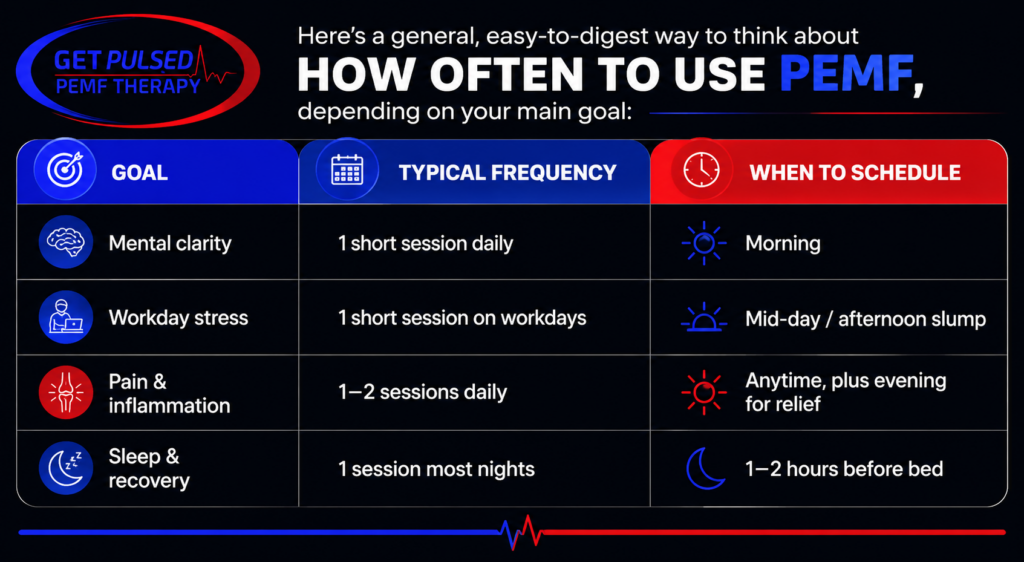
This isn’t a medical prescription, but a practical starting point. Your body, schedule, and device will always guide the final plan.
For more detailed protocols and professional oversight, Get Pulsed can help you match session timing to your current health status and goals.
If you’re ready to turn PEMF into a simple, passive habit instead of a confusing chore, contact Get Pulsed today at (602) 828-4478 to build a routine that fits your life, or call to book a PEMF session and feel the difference for yourself.
FAQs about How Often to Use PEMF Therapy
Is daily PEMF therapy safe to use?
For most healthy adults, low- to moderate-intensity daily PEMF use is generally considered safe, especially when following manufacturer guidelines and professional advice. If you have implants, serious health conditions, or are pregnant, always talk to your doctor before starting PEMF therapy.
How often should you use PEMF for pain relief?
Many people with pain use PEMF once or twice per day—often a general session plus a targeted one over the painful area. The key is to start with shorter sessions and moderate settings, then increase gradually based on how your body responds.
What is the best time for PEMF if I only have time once a day?
If your main goal is energy and focus, morning is often the best time for PEMF. If your priority is pain relief, stress reduction, or sleep, evening is usually the better slot. Choose the one time that matches your primary goal and stay consistent.
Can I overdo PEMF therapy if I use it too often?
More isn’t always better. Using very strong settings or very long sessions too often can make some people feel tired, wired, or uncomfortable. That’s why a balanced PEMF therapy daily routine focuses on steady, repeatable use, not maximum intensity.
How long should a PEMF session be in a daily routine?
Most home users or clients in wellness centers start with 10–20 minutes per session. As your body adapts and if you tolerate it well, some goals may benefit from 20–30 minutes. Always build up slowly instead of jumping straight to long sessions.
Can PEMF therapy replace my other treatments or workouts?
PEMF is better viewed as a supportive tool than a total replacement. It may complement exercise, physical therapy, sleep hygiene, or medical care by improving comfort, recovery, and overall resilience. Always follow your healthcare provider’s recommendations.
